How to Crash the Price of Saving Lives
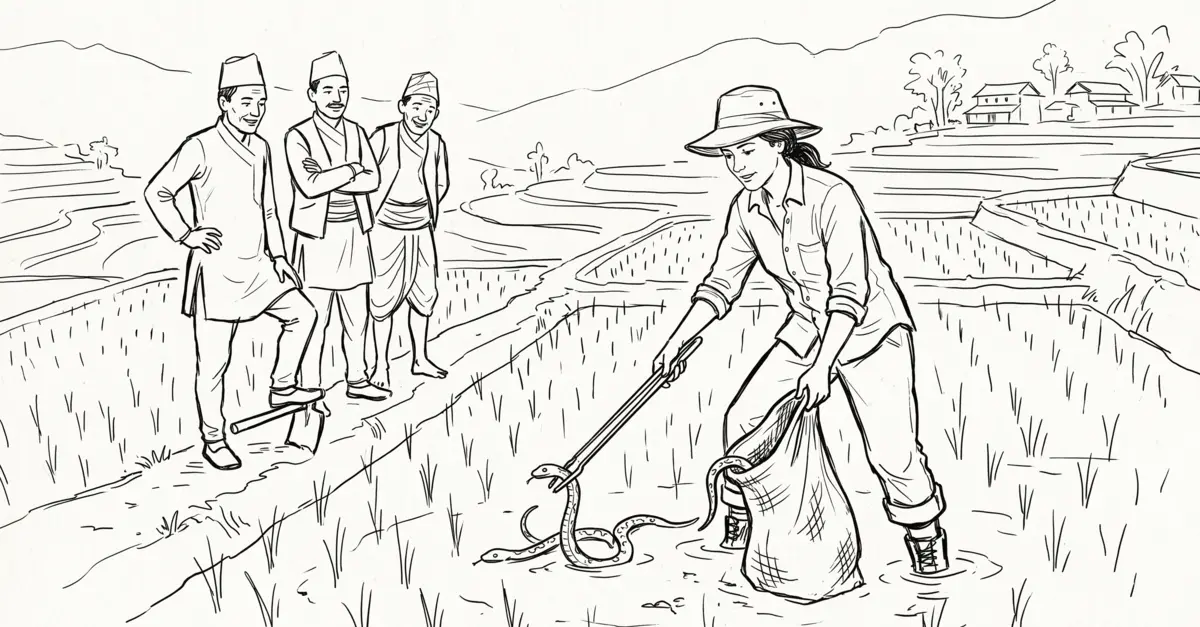
Every monsoon, in the flat southern strip of Nepal called the Terai, farmers go out to their fields and some of them do not come back. They are bitten by cobras while cutting rice, by Russell’s vipers walking home at dusk, by kraits that crawl into bed at night and bite them in their sleep. If they reach a hospital with the right antivenom in stock, they live. If they don’t, they die. Nepal does not have enough antivenom in the country.
The WHO estimates that snakebite kills between 81,000 and 138,000 people a year worldwide and leaves three times that many with permanent amputations or disabilities. It was designated a Category A Neglected Tropical Disease in 2017. The drug that prevents almost all of those deaths is a century-old technology: venom milked from snakes, injected into horses, antibodies harvested, purified, packaged. There are no patents. There is no R&D risk. The molecule works.
Nobody has a commercial reason to make it.
Here’s an experiment: what if you, a hypothetical billionaire, just bought the companies that make life-saving drugs and reset their prices to the cost of making them?
When you donate a dollar to buy a treatment, you implicitly accept the price of the treatment. If a course of antivenom costs $200, your dollar treats one two-hundredth of a snakebite. The seller sets the ceiling. The arithmetic is linear.
Acquisition breaks that arithmetic. Buy the company, reset the price to manufacturing cost plus a thin margin, and every dollar of post-acquisition revenue funds the next batch instead of the next shareholder dividend. What you’ve bought, for the same dollar, is the production line itself, and the unit economics for everyone downstream of it, forever.
Mark Cuban turned this into a business in 2022 with Cost Plus Drugs. Take the manufacturer’s cost, add a flat 15% markup, add a small pharmacy fee, and sell. Imatinib, the generic of Gleevec used to treat chronic myeloid leukaemia, retailed for around $9,657 a month at a typical US pharmacy when Cost Plus launched in 2022. On Cost Plus it cost $39. Pyrimethamine, which Martin Shkreli’s Turing Pharmaceuticals raised from $13.50 to $750 a pill in 2015, now sells on Cost Plus for under a dollar.
Cuban didn’t invent a drug or run a trial. He noticed that between the factory and the pharmacy sit middlemen, exclusivity deals, and opacity, and that you can refuse to participate in any of them. The molecules cost pennies; everything else is the markup. Cost Plus is the existence proof that the whole pricing structure was a choice, not a law of nature.
Imagine a small specialty pharma company with one drug, $50 million in annual revenue, treating a niche but lethal condition. The drug costs $5 a dose to manufacture and sells for $500. The company throws off $20 million a year in profit. You could donate $20 million annually to a charity buying the drug at retail and treat 40,000 patients a year. Or you could buy the company outright for $200 million, slash the price to $15, and treat over a million patients a year. Where donations fund the next treatment, an acquisition changes what every future treatment costs.
The target list, 2026 edition
The landscape has shifted enormously in couple of years, and most of the famous targets are no longer the right answer.
Tuberculosis is mostly out of the acquisition window. Until recently, the obvious target was bedaquiline, the cornerstone drug for drug-resistant TB, held by Johnson & Johnson under a thicket of secondary patents that priced it out of reach in most high-burden countries. After sustained pressure from MSF and a rejected patent extension in India, J&J agreed in 2023 not to enforce its secondary patents in 134 low- and middle-income countries, and the price of a treatment course dropped from $272 to $130. Generic supply is coming online through the Stop TB Partnership’s Global Drug Facility. The fight isn’t finished (Russia and China were excluded from the deal) but the bottleneck is no longer one company’s pricing decision.
Hepatitis C is similar. Gilead’s sofosbuvir launched at $84,000 for a 12-week course in 2013, against a manufacturing cost estimated at under $150. A decade later, generic sofosbuvir is available across most of the global south at $300 to $500 per cure under Medicines Patent Pool licences. Egypt eliminated Hep C as a national public health problem. You can’t buy Gilead, and you don’t need to. The remaining problem is diagnosis: huge numbers of Hep C carriers don’t know they’re infected.
Rare-disease price-gougers are still wide open. The pattern is consistent. A specialty pharma company acquires a decades-old generic with a niche but essential use, then raises the price by 10x, 100x, or 1000x. Daraprim is the famous case, but it isn’t the worst. Acthar Gel, a corticotropin used for infantile spasms, cost about $40 a vial in 2001 when Questcor bought the rights. Now the same drug sells for more than $40,000 a vial after Mallinckrodt’s acquisition of Questcor. The combined market cap of the dozen worst offenders is plausibly inside a single tech founder’s discretionary budget. The catch is patient population: buying these companies saves thousands of lives, not millions. The dollars-per-life ratio is still spectacular by philanthropic benchmarks. The absolute numbers are bounded by the disease.
Snakebite antivenom is one that’s overdetermined. There are no patents to break. The technology is mature. The R&D risk is low. The bottleneck is that almost nobody wants to manufacture the stuff because the margins are terrible and the customers are poor.
Sanofi, the only multinational producing a high-quality polyvalent antivenom for sub-Saharan Africa, stopped making Fav-Afrique in 2014 because it couldn’t compete on price with cheaper, lower-quality products from other producers. The last vials expired in 2016. In MSF’s project in northern Central African Republic, Fav-Afrique had reduced snakebite mortality to under 0.5%. After the switch to substitute products, some clinics reported a 7-to-20-fold increase in case-fatality rates.
This is a market where the failure mode isn’t extractive pricing. It’s the absence of any pricing at all.
If you wanted to fix that, the list of producers worth talking to is short. In India, Bharat Serums, VINS Bioproducts, and Premium Serums make most of the polyvalent antivenom used across South Asia. The South African Vaccine Producers consortium makes the SAIMR polyvalent that covers most of sub-Saharan Africa. MicroPharm in Wales makes the European stock. None of these are billion-dollar companies. A serious buyer could plausibly secure the South Asian and African supply lines for less than the price of a midsize office tower.
The hard part isn’t the money. It’s the willingness to lose money on purpose, every year, forever.
Sadly, the world’s poor are not customers of the worlds billionaires
Snakebite is the cleanest version of something that runs through every disease discussed in this post. The customers are poor. Producers respond to the customers’ wallets, not the lungs that need bedaquiline or the veins that need antivenom, and most of the wallets are empty. The market clears at whatever price the patients can pay, which for most of the planet is nothing.
John Green’s Everything Is Tuberculosis makes the same argument for the world’s deadliest infectious disease. We have had a cure since the 1940s, and TB still kills 1.25 million people a year, almost all of them in countries that don’t generate enough purchasing power to interest the companies that make the drugs. The biology was solved before my grandparents were born. The remaining problem is that the deaths happen to people we don’t count. Green’s central case is Henry Reider, a Sierra Leonean teenager whose tuberculosis was treatable, except that the treatment took years to arrive because nobody making the pricing decisions was counting him as a customer. The book is anchored in Sierra Leone, but the pattern recurs everywhere TB has a foothold: the disease persists wherever the patient cannot pay, and stops wherever they can.
The same dynamic shows up wherever you look around the world. Agricultural research that ignores subsistence crops. Vaccine portfolios that skip the diseases of the global south. Venture capital flowing toward the medical problems of people who already have insurance. Poor patients are missing from the math that decides what gets made, because nobody ever bothered to write them in. It’s difficult to treat those who have never been diagnosed in the first place.
Humanity has decided, by inaction more than by argument, that the price of staying alive is a function of where you happen to be born. Down in the Terai, that looks pretty shitty.
What you cannot buy
The other side of the target list is the long list of drugs where acquisition is the wrong tool. You cannot buy Pfizer or Novartis or Merck. The blockbuster oncology, immunology, and GLP-1 drugs that drive most pharmaceutical revenue sit inside companies with market caps in the hundreds of billions. Even a Bezos-scale acquisition would buy you partial equity, not the right to reset prices.
For those drugs, the playbook is different: compulsory licensing, march-in rights, patent pool negotiation, waiting for the cliff. The bedaquiline outcome came from MSF and the Indian Patent Office, not from anyone’s chequebook. A billionaire can fund the advocacy, but they can’t end-run the patent.
So why hasn’t anyone done this?
Bezos has more than $200 billion. The Gates Foundation has spent decades on exactly these diseases. Civica Rx, the non-profit generic manufacturer that US hospital systems stood up in 2018, was built precisely on this logic, though in practice it mostly addresses domestic hospital shortages of sterile injectables rather than crashing prices on global generics. The Medicines Patent Pool has been negotiating voluntary licences for fifteen years. So why is the antivenom market still broken?
Billionaires optimise for legacy, intellectual interest, tax efficiency, and the approval of their peers. Those pressures point at hospital wings and university buildings, not at small companies treating obscure diseases. Lives saved per dollar is not on the dashboard.
The regulatory work is also brutal. Buying a company is the easy part. Re-registering a drug at a new price across forty jurisdictions, each with its own pharmacovigilance and procurement rules, takes years and a dedicated team. Philanthropic capital has historically been allergic to running operating companies; foundations write grants, they do not run factories.
It is unglamorous, which is the entire reason the gap is still there.
The honest math
Suppose you actually did this. Suppose you ran a five-year programme of targeted acquisitions across the categories above. How many lives would you save?
Fewer than if you gave the same money to the Against Malaria Foundation.
That is the answer almost nobody wants to give, and it is the one to lead with. Bednets cost a few dollars. The intervention works without diagnosis, without prescription, without a clinic. GiveWell estimates AMF’s cost per life saved at around $5,500. Those are some of the most rigorously audited numbers in global health, and almost nothing in the pharmaceutical acquisition portfolio beats them on a per-life basis.
If you have $200 million, you can buy a serious snakebite antivenom producer and, assuming you also solve distribution, prevent perhaps 5,000 to 10,000 deaths a year going forward. Give the same money to AMF and you save roughly 35,000 lives at GiveWell’s current estimates. The acquisition arithmetic looks better over twenty years. The bednet arithmetic is much more likely to be true.
The reasons the acquisition math gets wobbly are the boring ones. A drug priced at $5 in a Mumbai factory is not a drug at $5 in a village clinic in Bihar, or in rural Kenya, or in the Nepali Terai. Between the factory gate and the patient sit cold chains, customs regimes, hospital procurement systems, prescribing physicians, and patient awareness. Diagnosis is its own problem: Hepatitis C and tuberculosis share a brutal feature, the cure works only if you find the patient. Drug-resistant TB takes six months of supervised treatment with significant side effects. ART for HIV is lifelong. Cancer treatment needs oncology nurses, infusion centres, pathology labs. None of that comes in a corporate acquisition.
The strategy also has a downside scenario. Crash a drug’s price and you may attract counterfeit producers selling lower-quality copies, which is roughly the dynamic that hollowed out the African antivenom market in the first place. A no-margin operating company has nowhere to absorb the cost of a single production failure (contamination, potency loss, cold-chain break) and can be offline for a year. Regulators in forty jurisdictions can each withdraw approval independently. Low margins are the strategy’s strength and its brittleness.
So the strategy that actually maximises lives per dollar is a portfolio. Most of the money goes to the highest-evidence direct interventions: bednets, vitamin A, deworming, vaccines, ORS. Almost as much funds the boring infrastructure that lets the rest of it work: diagnosis, surveillance, supply chains, regulators with budgets. A meaningful slice covers acquisitions where the math is unusually clean, which today means a small number of rare-disease price-gougers and one serious bet on snakebite antivenom for South Asia and sub-Saharan Africa. Whatever is left funds policy advocacy on the problems acquisitions can’t touch.
The lone-billionaire version of this story, dismantling Big Pharma with a war chest and a grudge, makes a better film. The real version runs on regulatory paperwork: a multi-year campaign of buying small companies, funding small clinics, and arguing in front of small committees, until the price of staying alive falls closer to the price of making the drug.
That is the practical answer. There is a harder one.
A race in the right direction
Billionaires already compete. They compete for buildings with their names on them, for placement on the Forbes 400, for whose yacht is longest. They compete in the wrong direction. The race that would actually matter is the inverse one: which billionaire can get off the list the fastest, by spending the fortune on the thing that prevents the most deaths. A leaderboard of who deployed their unearned advantage hardest, while it still mattered. The chance to be the change instead of buying another piece of it.
The closest thing this race already has to a leader is Mackenzie Scott. Since 2019 she has given away more than $19 billion in unrestricted grants to over 2,000 organisations. No foundation in her name, no buildings, no strings, no advisory committee deliberating in slow motion. She picks recipients quietly, writes the cheques, and lets them do the work. Mostly her money has gone to large established NGOs and community organisations rather than to neglected-disease pharma, which is fair enough; she is one person and she didn’t promise to fix everything. But she is running the right race. As far as I can tell, she is one of the few billionaires running it visibly.
It is tempting to point at governments instead. Governments are wasteful, slow, captured, and risk-averse, and all of that is partly true. They often provide an important social net. But the argument runs out the moment you notice the person making it has the resources to do the thing themselves and isn’t. The waste in even the worst bilateral aid programme is a rounding error against a billion dollars idling in a Cayman LLC. The honest version of the complaint is: governments aren’t doing enough, and neither am I, that statement hits hard and hurts.
The science already allows treating the world’s deadliest diseases at near-zero margin. The people with the means to close the gap are doing other things. To use the technical term, it is fucking embarrassing.
The thought experiment stops being a thought experiment at the snakebite-antivenom line. The drugs works, the regulators are accessible, the manufacturers are nameable, the patients are counted in tens of thousands a year, and the gap is just waiting for someone with the money to walk into it. Someone should go and do it. Maybe it’s you!
Feel free to subscribe to my newsletter, chat to me on mastodon or follow my blog in your favourite RSS reader.