Day 28 of 300: Base Run and the Bigger Picture
Two days ago I could barely function. Training readiness of 13, body trashed from the weekend. Yesterday I was still crawling back. Today, the plan was simple: get on the treadmill, run three honest kilometres, stay in Zone 3, don’t be a hero.
- Distance: 3.26 km
- Time: 25:02
- Pace: 7:41 /km (avg)
- Heart Rate: 136 bpm (avg) / 147 bpm (max)
- Calories: 348 kcal
- Training Effect: 3.4 (Aerobic Base)
Three 1km intervals with a short cooldown. Heart rate climbed steadily from 126 bpm in the first kilometre to 143 by the third - classic cardiac drift during sustained effort, nothing unusual. Pace held steady around 7:15-7:30/km across the three splits. The second kilometre was actually the fastest at 7:11/km, which either means I got into a rhythm or briefly forgot I was supposed to be taking it easy.
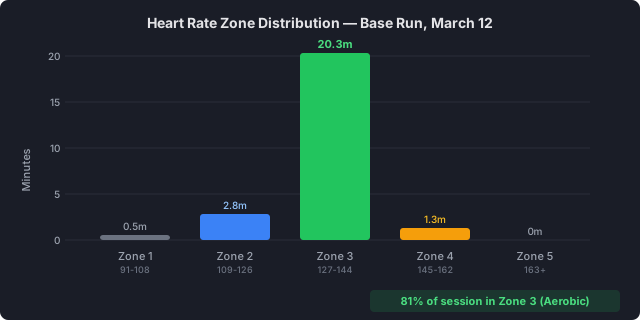
The Garmin classed it as “Aerobic Base” with a training load of 67. No anaerobic contribution at all. Zero time in Zone 5. 81% of the session sat squarely in Zone 3. This is exactly the kind of boring, unglamorous work that compounds over weeks.
The overreaching problem
Here’s the thing though. My acute training load has hit 300, which is 2.1x my chronic load of 137. Garmin flags anything above 1.3x as risky and mine is firmly in “Very High” territory. Training readiness after the session dropped to 1 out of 100. One. The algorithm is basically screaming at me to sit down.
This isn’t because I’m training like an elite athlete. It’s because I went from doing very little to cramming in sessions while still carrying the fatigue from the weekend. The body doesn’t care about your intentions, only the load.
The next 24-48 hours need to be recovery. Water, sleep, light movement, nothing more.
The bigger picture: fitness age
I went down a rabbit hole with the Garmin data tonight and found the fitness age metric. Turns out my body thinks I’m 44.3 years old. I’m 43. Not catastrophic, but not great either.
The interesting part is the breakdown of what’s dragging it up and what could pull it down:
- BMI (33.9): This is the biggest lever by far. Garmin says getting to a target of 21.4 would alone drop my fitness age to 38.5. That’s a massive gap, but even incremental progress here moves the needle more than anything else.
- Vigorous Minutes (40.8/wk): Target is 75 minutes per week. I’m doing about half of that. More sessions like today would close this gap.
- Vigorous Days (1.1/wk): Target is 3 days per week. Consistency matters more than intensity here.
- Resting Heart Rate (61 bpm): This one’s actually fine. The aerobic base work is paying off here at least.
The achievable fitness age is 37.1. Seven years younger than where I am now. That’s not a fantasy number - it’s what Garmin calculates based on hitting realistic targets across those four components.
What else is in the data
While I was digging, I pulled out a few other metrics worth tracking over time:
- VO2 Max: 39.0 mL/kg/min. This is the single best number for cardiovascular fitness. It needs to climb above 40 and keep going. Every point here improves race predictions and quality of life.
- Endurance Score: 4,367 (classified as “recreational”). The next tier is “intermediate” at 5,100. Running contributes about half my score, cycling and walking split the rest roughly evenly.
- Race Predictions: 5K in 29:08, 10K in 1:04:33, Half Marathon in 2:35:06. These will improve as VO2 Max climbs. The half marathon is the goal, so this is the benchmark to watch.
- HRV (Weekly Avg): 44 ms. This is the early warning system for overtraining. If this starts trending down while training load stays high, something needs to change.
- Sleep Score (2-week avg): 63. This is dragging down training readiness. The past two weeks have been rough - averaging 6.3 hours per night with only one night above 7 hours. Sleep is the free performance enhancer I keep leaving on the table.
- Body Composition: No weigh-ins recorded in the past two weeks. Need to get back to tracking this since it’s the biggest factor in fitness age.
None of these numbers are where I want them to be. But they’re all measurable, they’re all improvable, and now I know what levers to pull. The fitness age target of 37.1 gives the whole thing a concrete goal beyond just “do 300 sessions”.
Time to recover, then get back after it.
Feel free to subscribe to my newsletter, chat to me on mastodon or follow my blog in your favourite RSS reader.